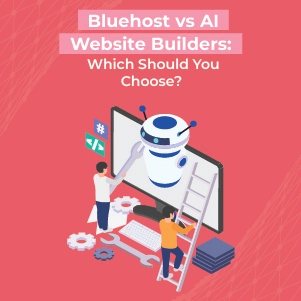
Creating a professional website used to take weeks of writing custom code, complex templates, and endless plugins. Today, AI website builders can generate a fully functional site in seconds from a simple prompt.
Yet for creators who demand complete control, deep customisation, and long-term scalability, traditional web hosting platforms remain indispensable. Because both approaches solve completely different problems, choosing between them isn’t as simple as comparing a list. The real question is: What does your site actually need today, and where is it heading tomorrow?
In this guide, we evaluate how Bluehost compares to AI website builders, helping you make the smartest choice for your goals and budget.
A. What Are We Actually Comparing?
Before picking a side, it helps to understand that Bluehost and AI website builders aren’t quite doing the same job, which is exactly why the Bluehost vs AI website builders debate confuses so many first-time website owners.
1. What Bluehost Offers
As a leading web hosting company, we rent you server space, give you a domain, and provide the infrastructure your website actually lives on. So, you get near-total control over design, plugins, functionality, and how your site grows over time. Think of it as owning the plot of land, and you get to decide what goes where.
2.What AI Website Builders Offer
AI website builders, such as Wix ADI, Hostinger AI, Durable, or 10Web operate on a completely different model. They’re closed platforms where the AI does the heavy lifting: layout, copy suggestions, images, even colour schemes, often creating your entire design and copy from just a brief description of your business. You don’t manage hosting separately because it’s bundled in.
It’s less “build a house” and more “move into a furnished apartment”.
B. Bluehost Hosting vs AI Website Builder: A Feature-by-Feature Look
1. Ease of Use
AI builders win here, at least initially. You answer a few questions, and the tool generates a working site in minutes. Bluehost with WordPress takes a bit more setup. You have to choose a theme, install plugins, and arrange pages. But that initial effort pays off with far more room to grow later.
2. Design Flexibility and Customisation
This is where the gap widens. WordPress on Bluehost has access to tens of thousands of themes and plugins, so your site can eventually look and function however you want. AI builders are more templated. They’re great for a clean, simple site, but you’ll hit a ceiling fast if your business needs something more custom.
3. SEO Performance
Search visibility is often the deciding factor for small businesses, and it’s worth being honest about here. Bluehost paired with WordPress gives you granular SEO control, including plugins like Yoast or Rank Math, custom schema, detailed site speed tuning, and full access to your site’s code when you need it. AI builders have improved a lot on baseline SEO (most now generate meta tags and clean URLs automatically), but they rarely offer the same depth of control once your traffic starts growing and your SEO needs get more specific.
4. Scalability and Growth
A one-page site for a local bakery might never outgrow an AI builder. But if you’re planning to add a blog, an online store, gated content, or multiple team logins down the line, Bluehost’s infrastructure and WordPress’s ecosystem scale with you in a way most closed AI platforms simply aren’t built to.
5. Pricing
This is where it gets interesting, and where we think a lot of the marketing noise falls apart. AI website builders often advertise low entry prices, but many core features, such as custom domains, e-commerce, branding, etc., sit behind higher tiers. Bluehost’s hosting plans are competitively priced from the start and typically include a free domain, free SSL, and enough storage and bandwidth for most small sites without needing to upgrade right away.
C. AI Website Builder for Small Businesses: When AI Tools Actually Make Sense
To be fair to AI builders, there are real situations where they’re the smarter pick. If you need a landing page live today for an event, a simple portfolio, or a proof-of-concept for an idea you’re still testing, an AI website builder gets you there with almost no friction. For a solo founder validating a business idea before committing to anything bigger, this speed has real value.
That said, when people search for the best AI website builder for small businesses, what they usually need isn’t just speed; it’s a foundation that won’t need to be rebuilt from scratch six months later. That’s the part worth thinking through before you commit.
D. When Bluehost Makes More Sense
E. Can You Get the Best of Both Worlds?
Here’s something a lot of people don’t realise: this doesn’t always have to be a strict either-or decision. Bluehost has been steadily rolling AI-assisted tools into its own onboarding, helping you generate layouts and starter content faster while still hosting everything on infrastructure you actually own and control. So you get a chunk of that “instant site” convenience without giving up the flexibility to customise, scale, and optimise later.
If you’ve been doing an AI website builder comparison purely to save setup time, it’s worth checking what Bluehost’s own tools can already do before assuming you need a separate platform entirely.



Leave a Reply